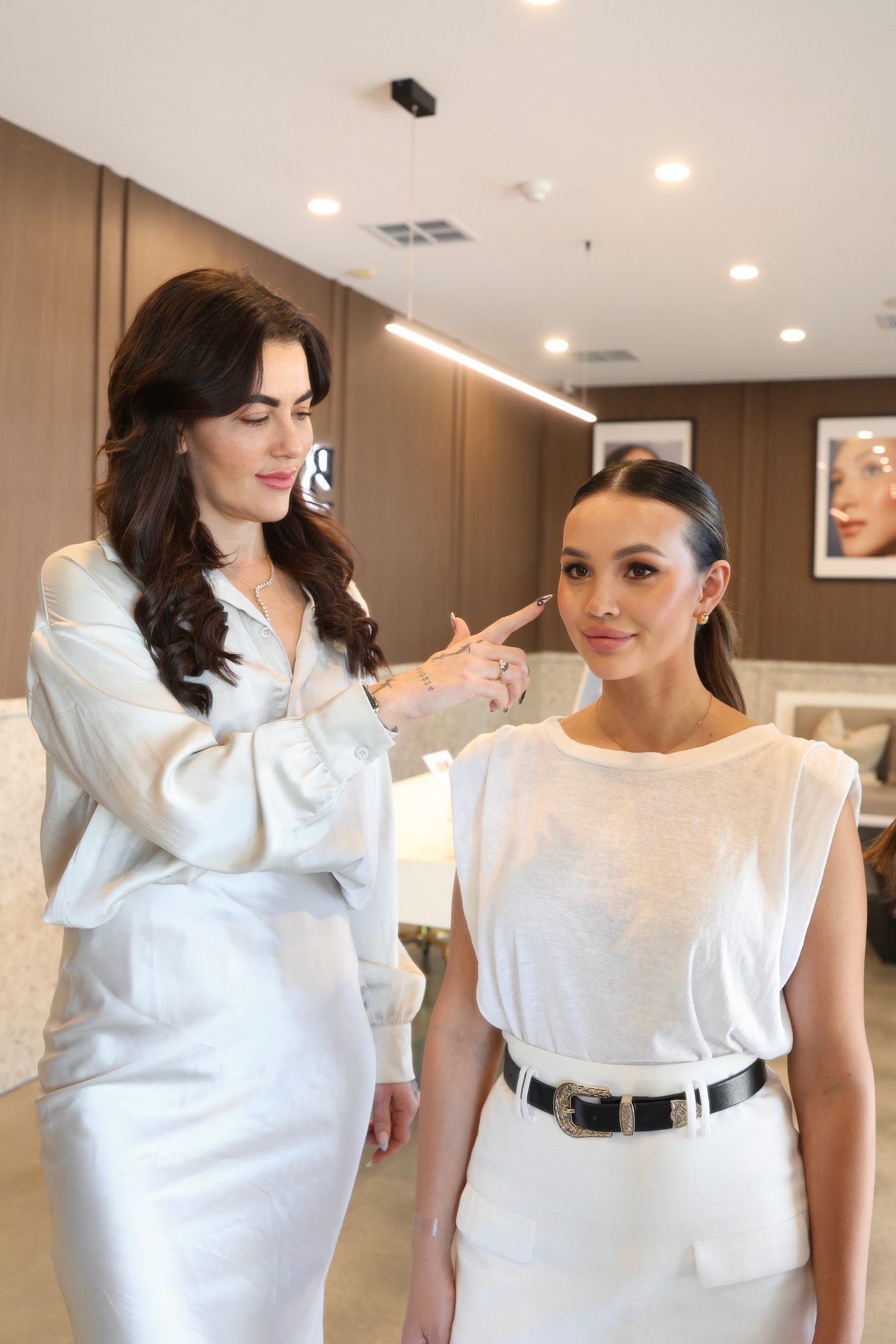
What Is A Downturned Smile (DAO)?
A downturned smile refers to the position of the mouth corners at rest, sitting lower than neutral and giving the face a sad, heavy, or stern appearance even when the person feels nothing of the sort. It can be a natural anatomical feature present from youth, or something that develops and worsens over time as the lower face changes structurally. Either way, the concern is the same: the face is communicating something the person does not feel.
The Anatomy of a Downturned Smile

Understanding why the mouth corners turn downward is the first step toward effective correction. Most cases fall into three categories:
Muscular Pull
An overactive DAO muscle creates a constant downward tension, resulting in a persistent downturned look at rest.
Loss of Support
Age-related volume loss and increased skin laxity lead to a lack of structural support, causing the oral commissures to drop.
Inherited Structure
Many people have an inherited facial anatomy where the mouth corners sit naturally lower. This is a stable, non-progressive feature rather than an age-related change.
When Does a Downturned Smile Become More Noticeable?
For those with an anatomical predisposition, the concern may have always been present. For others, it tends to emerge or deepen through the mid 30s and beyond as lower face volume decreases and skin laxity increases.
Many people first register it in photographs or on video calls, where the lower face reads more heavily than it does face-on in a mirror. The point at which most people raise it is when someone asks why they look unhappy or serious when they feel completely at ease.
Treatments That May Assist With a Downturned Smile
Dermal Enhancements for Downturned Smile Support
Where volume loss in the lower face is contributing to the downturned position of the mouth corners, dermal enhancements may be considered to provide structural support in appropriate cases.
PDO Thread Lifts for Downturned Smile Support
Where soft tissue descent is a contributing factor, PDO thread lifts may assist in repositioning and supporting the lower face in appropriate cases.
Anti-Wrinkle Treatments for Downturned Smile Support
By reducing DAO muscle activity, anti-wrinkle treatments may help soften the downward pull on the mouth corners in suitable candidates.
Skin Hydration Treatments for Downturned Smile
Skin hydration treatments may support tissue resilience in the lower face, complementing other approaches where skin quality is a contributing factor.
Collagen-Stimulating Treatments for Downturned Smile
Collagen-stimulating treatments may assist in improving skin firmness around the mouth and lower face, which can influence how the mouth corners sit at rest.
What to Know Before Exploring Options
Anatomy vs. Aging: Two Distinct Clinical Starting Points
Whether a downturned smile has always been present or has developed over time matters when it comes to understanding what may help. A lifelong feature driven by inherited facial structure and a progressive change driven by volume loss and muscle activity are different presentations that call for different approaches. Understanding which applies to your situation is the starting point for any meaningful conversation about options.
A Downturned Smile and Marionette Lines Are Related but Not the Same
A downturned smile refers specifically to the position of the mouth corners at rest. Marionette lines are the creases and hollows that develop below the mouth corners toward the chin. They often appear together and share common contributing factors, but they involve different anatomy and are assessed and addressed differently. A whole-face assessment considers both in the context of the lower face as a whole.
Why our Clients Seek Guidance for a Downturned Smile (DAO)
Most people seek guidance when their face reads as unhappy or serious in photographs or during conversations, when they feel neither. For some it is a concern they have carried since their 20s. For others it has developed gradually alongside broader lower face changes and they want to understand what is actually driving it before deciding whether options are worth exploring. There is no threshold to meet before asking the question.
Frequently Asked Questions About The Downturned Smile (DAO)
Is a downturned smile always caused by the DAO muscle?
Not always. While the DAO muscle is a significant contributor, particularly where the concern is longstanding or where the downward pull is clearly movement-driven, structural changes including volume loss, skin laxity, and lower face descent can also contribute independently or alongside muscle activity.
Can a downturned smile be present from a young age?
Yes. Some people have a naturally lower mouth corner position due to inherited facial structure rather than age-related change. In these cases, the concern is anatomical rather than progressive, though it may become more noticeable over time as surrounding facial changes occur.
Is a downturned smile the same as marionette lines?
No. A downturned smile refers to the position of the mouth corners at rest. Marionette lines are the creases and hollows that extend below the mouth corners toward the chin. They are related and often appear together, but they are distinct concerns assessed and addressed differently.
Will treating the DAO muscle change how my smile looks during expression?
The aim of any approach involving the DAO muscle is to soften the downward pull at rest without affecting the natural range of expression. Whether this is appropriate and how it might affect movement is assessed and discussed individually during a consultation before any treatment is considered.
How do I know whether my concern is muscle-related or structural?
A bespoke consultation at Blume allows for assessment of your lower face anatomy, muscle activity, skin quality, and volume distribution to identify what is contributing to the concern and whether any options may be appropriate for your individual situation.
Can a downturned smile be present on one side more than the other?
Yes. Natural facial asymmetry means the mouth corners rarely sit at exactly the same height on both sides. One side being more downturned than the other is common and is taken into account during assessment, with the aim of working with the face’s natural balance rather than imposing artificial symmetry.
Disclaimer
This page is intended for general educational purposes and does not constitute medical or therapeutic advice. All services are discussed following a consultation with a qualified practitioner, in accordance with TGA and AHPRA guidelines. Individual suitability, outcomes, and any potential risks will be assessed on a case-by-case basis and clearly communicated before any treatment is offered.